DSCR Loans: The Complete Guide for Real Estate Investors in 2026
Everything you need to know about DSCR loans — how they work, qualification requirements, current rates, and why Detroit investors need to model property taxes correctly.
Market focus: Detroit & Michigan

If you've ever tried to finance a second or third investment property using a conventional mortgage, you know the problem. The underwriter wants two years of tax returns. Your write-offs have pushed your taxable income down. The debt-to-income ratio calculation includes every loan you're already carrying. And suddenly, a deal that makes complete financial sense on paper gets killed by paperwork.
DSCR loans were built specifically to solve this.
They're now one of the most widely used financing tools in the real estate investor's toolkit — and in 2026, with rates becoming increasingly competitive and qualification requirements more flexible than ever, they've become the default long-term financing vehicle for serious buy-and-hold and BRRRR investors.
This guide covers exactly what DSCR loans are, how the math works, what lenders look for, and — critically — how your DSCR calculation is affected by Detroit-specific factors that most national guides never mention.
What Is a DSCR Loan?
A DSCR loan(Debt Service Coverage Ratio loan) is a type of investment property mortgage where qualification is based on the property's rental income — not your personal income, W-2s, tax returns, or employment history.
Instead of asking "can this borrower afford this loan?", a DSCR lender asks: "does this property generate enough income to cover its own mortgage payment?"
That single shift changes everything for investors. It means:
- A self-employed investor with aggressive write-offs can still qualify
- An investor with 8 financed properties can still add a ninth
- An LLC can take out the loan directly, keeping it off personal credit reports
- Qualification is based on real estate fundamentals — not personal finance paperwork
DSCR loans are classified as non-QM (non-qualified mortgage)products, meaning they operate outside the conventional Fannie Mae/Freddie Mac guidelines. They're offered by private lenders, portfolio lenders, and an expanding set of institutional non-QM originators — not typically by traditional banks.
How DSCR Is Calculated

The DSCR formula is straightforward:
DSCR = Gross Monthly Rent ÷ Monthly PITIA
Where PITIA = Principal + Interest + Taxes + Insurance + HOA (if applicable)
So if a property rents for $1,400/month and the total monthly PITIA is $1,120:
$1,400 ÷ $1,120 = DSCR of 1.25
This means the property generates 25% more income than it needs to cover the mortgage — which lenders view as a healthy cushion.
What Different DSCR Ratios Mean
| DSCR | What It Means | Lender Interpretation |
|---|---|---|
| Below 1.0 | Rent doesn't cover the mortgage | High risk — most lenders decline or require significant reserves |
| 1.0 | Rent exactly covers the mortgage | Breakeven — some lenders approve with stronger credit/reserves |
| 1.1 – 1.24 | Modest positive coverage | Acceptable — qualifies with most lenders |
| 1.25+ | Strong positive coverage | Best terms, lowest rates, easiest approval |
| 1.5+ | Excellent coverage | Premium pricing tier at most lenders |
Most lenders in 2026 set their minimum DSCR at 1.0, though the best rates and terms are typically reserved for ratios at 1.25 and above. Some lenders will go below 1.0 for strong borrowers with high credit scores and substantial reserves.
The Detroit Factor: Why Your DSCR Calculation Is Different Here
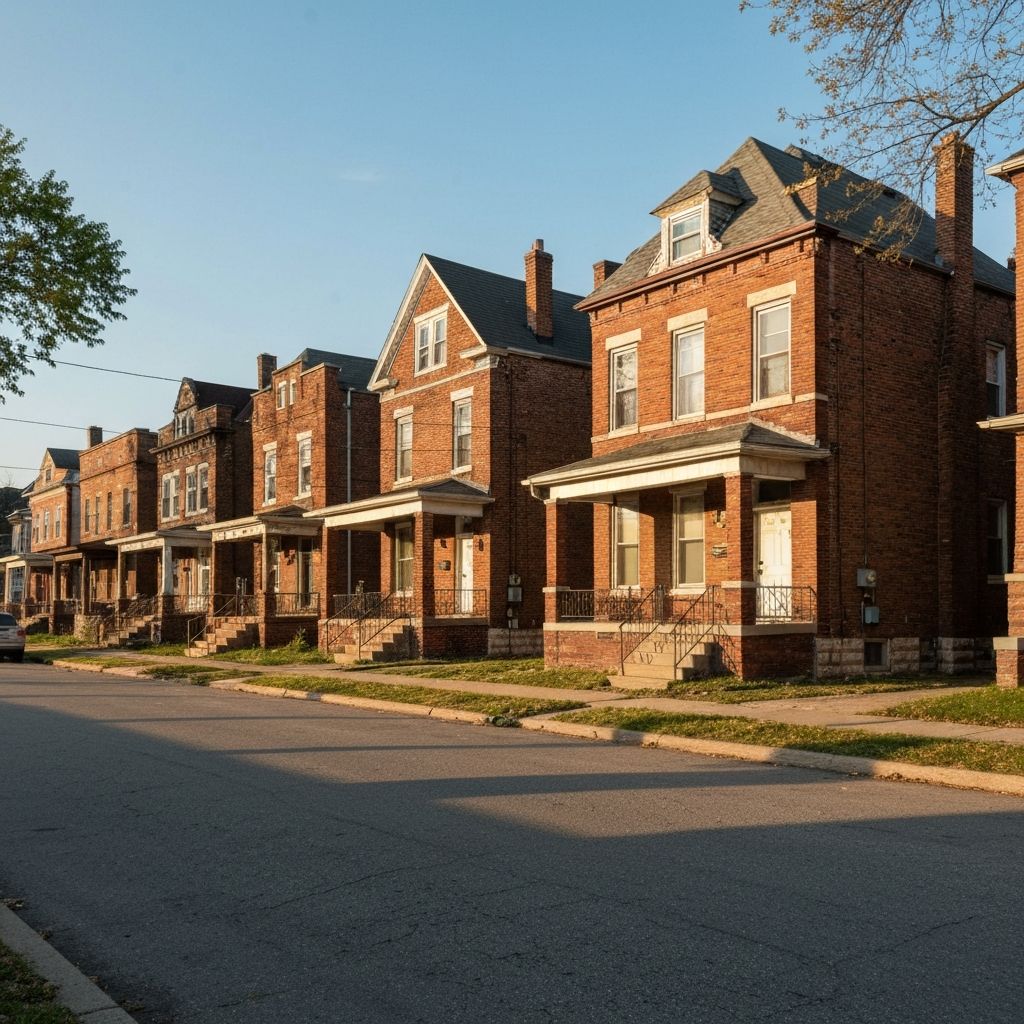
This is where most national DSCR guides fail Detroit investors. The formula is the same, but the inputs are different — and getting them wrong can make or break your financing.
Property Taxes at the Non-Homestead Rate
In Michigan, properties owned by investors (not owner-occupants) are taxed at the non-homestead millage rate — roughly 70 millsin Detroit. Owners who live in their property qualify for the PRE (Principal Residence Exemption), which drops the effective rate to about 18 mills. As an investor, you don't get the PRE.
On a property with a $110,000 ARV, the annual tax difference is significant:
| Scenario | Taxable Value | Annual Tax | Monthly Tax |
|---|---|---|---|
| Owner-occupied (18 mills) | $55,000 | ~$990 | ~$83 |
| Investor-owned (70 mills) | $55,000 | ~$3,850 | ~$321 |
That's a $238/month difference in your PITIA — which directly compresses your DSCR.
Example: A property renting for $1,350/month with a $950 principal+interest payment looks like this:
- With 18-mill tax estimate (wrong): PITIA = $1,033 → DSCR = 1.31 ✓
- With 70-mill tax estimate (correct): PITIA = $1,271 → DSCR = 1.06 ⚠
That's the difference between easy approval and borderline qualification — and it's entirely caused by using the wrong tax assumption.
Know your DSCR before your lender does
Homestream calculates your DSCR using Detroit's actual 70-mill investor tax rate — not the owner-occupied rate that national tools default to.
Run Your DSCR AnalysisDSCR Loan Requirements in 2026
Requirements vary by lender, but here are the current market standards:
Credit Score
- Minimum: 620 (most lenders)
- Best rates: 720–740+
- Every 20-point FICO improvement typically improves your rate
Down Payment / LTV
- Purchases: 20–25% down (75–80% LTV)
- Cash-out refinance: 70–75% LTV
- Some lenders: 15% down available for strong borrowers at higher rates
DSCR Ratio
- Minimum: 1.0 (most lenders in 2026)
- Best terms: 1.25+
- Below 1.0: Possible with high credit score and substantial reserves, but rare
Reserves
- Typically 3–12 months of PITIA in liquid reserves post-closing
- More properties in your portfolio = more reserves required
Property Type
- Single-family rentals: standard
- 2–4 unit properties: standard
- 5+ units: typically requires commercial DSCR, different product
- Short-term rentals: eligible with many lenders, using STR income projections
- Properties must be non-owner-occupied
Current DSCR Loan Rates (April 2026)
As of April 2026, DSCR loan rates commonly range from 6.12% to 6.37% for domestic investors, depending on DSCR ratio, LTV, and overall deal structure.
What lowers your rate:
- Higher DSCR ratio (1.25+ vs. 1.0)
- Lower LTV (65–70% vs. 75–80%)
- Higher credit score (740+ vs. 680)
- Longer prepayment penalty (5-year PPP vs. none)
- Larger loan amount (above $150K)
What raises your rate:
- DSCR close to minimum (1.0–1.1)
- Higher LTV (80%+)
- Credit score below 700
- Small loan amounts (under $100K)
- Cash-out refinance (+0.25–0.50% vs. purchase)
DSCR Loans vs. Conventional Investment Property Loans
| Factor | DSCR Loan | Conventional |
|---|---|---|
| Income documentation | None required | Full — W2s, tax returns, paystubs |
| Qualification basis | Property cash flow | Personal DTI ratio |
| Max financed properties | Unlimited | 10 (Fannie Mae limit) |
| LLC closing | Yes | No (typically) |
| Down payment | 20–25% | 15–25% |
| Self-employed friendly | Yes | Challenging |
DSCR in the BRRRR Strategy
DSCR loans are the most common long-term financing vehicle used in BRRRR deals. Here's where they fit in the two-phase structure:
Phase 1 — Acquisition and Rehab: Hard money or private money (short-term, asset-based, 6–12 months)
Phase 2 — Refinance and Hold: DSCR cash-out refinance (long-term, stabilized rental, 30-year term)
The DSCR Refinance Math for a Detroit BRRRR
Using a real Detroit deal profile:
| Purchase price | $52,000 |
| Rehab cost | $30,000 |
| Closing and carry costs | $6,000 |
| Total cost basis | $88,000 |
| ARV (post-renovation) | $125,000 |
| DSCR refinance at 75% LTV | $93,750 |
| New loan payoff (hard money) | $88,000 |
| Cash returned to investor | $5,750 |
Monthly DSCR check:
- Monthly rent: $1,350
- PITIA at $93,750 / 30yr / 6.5%: ~$594 P&I + $321 taxes (70 mill) + $100 insurance = $1,015 PITIA
- DSCR: $1,350 ÷ $1,015 = 1.33 ✓
This deal clears most lenders' DSCR minimums comfortably — precisely because the Detroit property taxes were modeled correctly from the start.
What to Watch Out For
Prepayment Penalties
Most DSCR loans come with prepayment penalties — typically a 3-5 year step-down structure (e.g., 5/4/3/2/1). If you sell or refinance within the penalty period, you pay a percentage of the loan balance. For a BRRRR strategy where you plan to hold long-term, this is usually a non-issue.
Lender Variability on Detroit Properties
Not all DSCR lenders are comfortable with Detroit markets. Some national lenders apply geographic restrictions on certain Detroit zip codes, view Detroit as high-risk, or use automated valuation models that produce unreliable estimates. Work with lenders who have actual Detroit lending history.
Appraisal Risk
DSCR lenders require a full appraisal. The appraisal determines both the property value (which sets LTV) and market rent (which sets the DSCR). If either comes in below your projection, your loan proceeds drop and/or your DSCR tightens. Model conservatively on both.
Frequently Asked Questions
Can I get a DSCR loan with no rental history on the property?
Yes. DSCR lenders use market rent (from a rent appraisal or rent comps), not actual lease history, to qualify the property. A vacant property can be DSCR-financed as long as the appraiser supports the projected rent.
Do I need good personal credit for a DSCR loan?
Credit score matters for rate and terms. Most lenders require 620+ to qualify, but rates improve meaningfully above 720–740. Credit score is one of the primary rate drivers alongside DSCR ratio and LTV.
Can I use a DSCR loan for a short-term rental?
Yes, with many lenders. STR-eligible DSCR lenders use projected STR income (often derived from platforms like AirDNA) rather than standard long-term market rent. Rates may carry a small premium.
How is DSCR different from a hard money loan?
Hard money is short-term (6–24 months), high-rate (9–13%), used for acquisition and rehab. DSCR is long-term (30 years), lower-rate (6–8%), used for stabilized rental properties. In a BRRRR deal, hard money is the acquisition tool and DSCR is the exit.
Can I refinance an existing rental with a DSCR loan?
Yes. DSCR cash-out refinances are common — and popular with BRRRR investors exiting hard money positions. Cash-out DSCRs typically price 0.25–0.50% higher than purchase transactions and lend at 70–75% LTV.
Final Thoughts
DSCR loans are not a workaround or a shortcut. They're purpose-built financing for real estate investors — and in 2026, they've matured into a legitimate, competitive product that in many cases offers better economics than conventional investment property financing.
For Detroit investors specifically, the key is modeling the deal correctly before you go to a lender. Detroit's 70-mill investor tax rate is not a footnote — it's a primary variable that moves DSCR by meaningful margins, and it needs to be calculated accurately from day one.
Homestream builds that calculation into every deal analysis automatically. Enter the address, run the numbers, know your DSCR before your lender does.
Analyze your deal's DSCR on Homestream
Enter an address. Get your DSCR calculated with Detroit's actual investor tax rate. Know if your deal qualifies before you apply.
Start Your AnalysisThis guide is for educational purposes and does not constitute financial or legal advice. Consult with qualified professionals before making investment decisions.