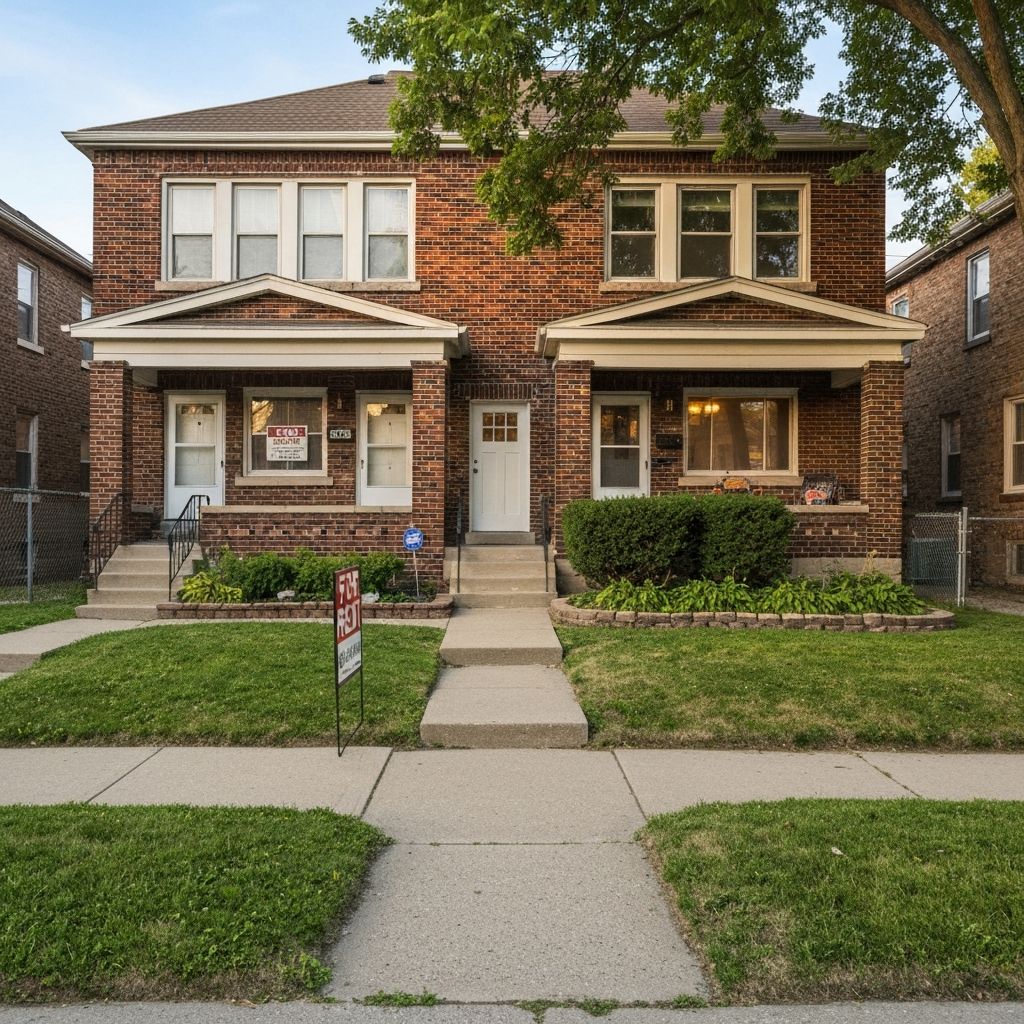
Most people think real estate investing requires a large down payment, a separate pool of capital, and the experience to manage a property you don't live in. House hacking challenges all three of those assumptions — and for a specific type of first-time investor, it's the most accessible, lowest-risk entry point into building a real estate portfolio.
The concept is simple: buy a multi-unit property, live in one unit, rent out the others. Your tenants' rent helps pay — or in the best cases, fully covers — your mortgage. You build equity, learn how to operate a rental property, and accumulate the track record that makes your next deal easier.
It doesn't work for everyone. There are real trade-offs, and the "live rent-free" narrative often glosses over the operational realities of sharing walls with your tenants. But for the right buyer in the right market, house hacking is one of the smartest wealth-building moves available — especially in Detroit, where property prices still support cash flow math that most other major cities can't touch.
What Is House Hacking?
House hacking is the practice of purchasing a property as your primary residence and renting out part of it to generate income that offsets your housing costs.
The most common versions:
Multi-unit house hacking (the classic):Buy a duplex, triplex, or fourplex. Live in one unit. Rent out the remaining 1–3 units. Your tenants' rent reduces or eliminates your out-of-pocket mortgage payment.
Single-family house hacking: Buy a single-family home with an ADU (accessory dwelling unit), finished basement apartment, or carriage house. Rent the secondary unit while living in the main house.
Room-by-room house hacking: Buy a single-family home with multiple bedrooms. Rent individual rooms to roommates. Higher gross yield but more daily interaction with tenants — suits some people and absolutely does not suit others.
The core principle across all versions is the same: you're using someone else's rent payments to subsidize or eliminate your own housing cost, while simultaneously building equity in an asset that can become a standalone investment property when you eventually move out.
Why House Hacking Gets First-Time Investors in the Door
The two biggest barriers to real estate investing for most people are capital and confidence. House hacking lowers both.

The Capital Advantage: Owner-Occupied Financing
This is the mechanic that makes house hacking financially distinct from any other investment strategy.
Investment properties — the kind you don't live in — require 20–25% down payments with conventional financing. A $200,000 investment property requires $40,000–$50,000 out of pocket before you close.
Owner-occupied properties play by different rules. Because you're living in the property, you qualify for residential mortgage programs designed for homebuyers — not investors — with dramatically lower down payment requirements:
FHA Loans (most common for house hacking)
- Down payment: 3.5% (with credit score 580+)
- Works for 1–4 unit properties as long as you live in one unit
- Lenders can count 75% of projected rental income from the other units to help you qualify
- Requires owner-occupancy for at least 12 months
- Includes Mortgage Insurance Premium (MIP): 1.75% upfront + ~0.55% annually
Conventional Loans (for buyers with stronger credit)
- Down payment: 5% for 2-unit, 10–15% for 3–4 unit
- PMI cancels when you reach 20% equity (unlike FHA)
- Generally better long-term cost if you can qualify
VA Loans (for eligible veterans)
- Down payment: 0%
- No mortgage insurance
- Eligible for 1–4 unit properties with owner-occupancy
- Arguably the most powerful house hacking financing available
The practical effect: instead of needing $40,000–$50,000 to enter real estate as an investor, a first-time house hacker in Detroit might need $8,000–$15,000 in a down payment plus closing costs and reserves. That's a fundamentally different capital requirement.
The Confidence Advantage: Learning by Doing
House hacking puts you in the landlord role with a built-in safety net — you're on-site. You learn how to screen tenants, write a lease, handle maintenance requests, and manage the financial side of rental property ownership while the stakes are lower than a property you're managing from across town.
The House Hacking Math: A Detroit Example
Abstract concepts are fine. Numbers are better.
Scenario: FHA House Hack on a Detroit Duplex
| Line Item | Amount |
|---|---|
| Property (duplex, east side Detroit) | $160,000 |
| FHA down payment (3.5%) | $5,600 |
| Estimated closing costs | $5,500 |
| Initial reserves (recommended) | $8,000 |
| Total cash needed to close | ~$19,000 |
Monthly picture after closing:
| Income / Expense | Monthly |
|---|---|
| Rent from Unit 2 (market rate) | +$1,100 |
| Principal + Interest (6.5%, 30yr) | $978 |
| Property taxes (70-mill investor rate) | $280 |
| Homeowner's insurance | $120 |
| FHA MIP (monthly) | $75 |
| Total PITI + MIP | $1,453 |
| Your out-of-pocket after rental income | $353/month |
That's a $353/month housing cost — for a property you're building equity in, in a neighborhood where comparable rents for a single-family might be $1,100–$1,300/month. You've reduced your housing cost by 70%+ while starting to accumulate real estate equity.
Run Your House Hack Numbers
Homestream's FHA house hacking analysis models your scenario with Detroit-accurate inputs: the correct non-homestead tax rate, market rent comps, and your actual monthly out-of-pocket.
Analyze Your First House HackThe FHA Self-Sufficiency Test (3–4 Unit Properties)
If you're buying a triplex or fourplex with an FHA loan, you'll encounter the self-sufficiency test — an FHA requirement that applies specifically to 3–4 unit properties.
The rule: the projected rental income from all units (including the one you'll live in, at market rate) must equal or exceed the total PITI payment on the property.
This sounds restrictive, but in Detroit's market it's often passable. A fourplex where each unit rents for $900–$1,000/month generates $3,600–$4,000 in projected gross rent — which needs to cover the full PITI on a property you may have acquired for $180,000–$250,000. In many Detroit neighborhoods, that math works.
House Hacking vs. Traditional Investing
| Factor | House Hacking | Traditional Investment |
|---|---|---|
| Capital available | $10,000–$25,000 | $35,000–$60,000+ |
| Live near tenants? | Yes | No |
| Timeline | First deal, learning | Experienced, scaling |
| Current housing | Renting, flexible | Own primary residence |
| Strategy fit | FHA as on-ramp | BRRRR, buy-and-hold |
The Honest Trade-offs

Any guide that sells house hacking purely on the financial upside is leaving out the parts that determine whether it actually works for you.
You are a landlord from day one.That means handling maintenance calls, lease renewals, security deposit disputes, and the occasional 10pm text about a water leak — all while it's also your home. Some people adapt to this quickly. Others find it genuinely disruptive.
Privacy is real. Living adjacent to your tenant means noise, shared walls, shared parking. The design of the specific property matters enormously here — a well-configured duplex with separate entrances feels very different from a poorly converted single-family.
Tenant screening matters even more.When a bad tenant is in a property across town, it's a management problem. When a bad tenant is in the unit next door, it's a daily quality-of-life problem. Screen hard.
FHA MIP doesn't go away on its own. Unlike conventional PMI, FHA mortgage insurance lasts the life of the loan. The standard exit: refinance into a conventional loan once you have 20–25% equity.
You need reserves. Walking into ownership with nothing left in the bank is how house hackers get into trouble. Aim for 3–6 months of PITI in reserves after closing.
House Hacking in Detroit: Why the Market Works
Detroit is one of the best markets in the country for FHA house hacking:
- Property prices support the math. A 2–4 unit property in a quality Detroit neighborhood can often be acquired for $150,000–$250,000. At 3.5% down, that's $5,250–$8,750 — achievable for a first-time buyer.
- Rents support meaningful offset. Per-unit rents of $900–$1,300/month for a renovated unit are realistic. One rented unit covers 65–75% of typical monthly PITI.
- The 12-month cycle creates portfolio momentum. After 12–24 months, move into the next house hack (new FHA loan, 3.5% down again), leave the first property fully rented. Repeat.
Is House Hacking Right for You? The Self-Assessment
Financial readiness
- Do you have 3.5–5% of target price plus closing costs plus 3–6 months reserves?
- Does your income support FHA qualification (DTI under 43–50%)?
- Is your credit score 580+ (ideally 620+)?
Life situation fit
- Are you currently renting with flexibility on where you live?
- Are you comfortable sharing building infrastructure with tenants for 12–24 months?
- Are you willing to be available as a landlord?
Operational readiness
- Are you prepared to learn tenant screening, lease drafting, and maintenance coordination?
- Do you have (or will build) relationships with reliable contractors?
- Are you willing to treat the rental units as a business?
The Transition: From House Hack to Portfolio
The real power of house hacking isn't the first deal. It's what it enables.
Month 13+: You move out, rent Unit 1, and own a cash-flowing multifamily property with owner-occupied financing terms.
Deal 2: Use FHA again on a new primary residence — another house hack, or a traditional BRRRR deal funded conventionally.
Repeat: Each house hack you transition out of becomes a permanent cash-flowing asset. Many Detroit investors who now hold 5–10 properties started exactly this way.
Final Thoughts
House hacking is not the flashiest real estate strategy. It doesn't generate the headline returns of a perfectly executed BRRRR or a well-timed flip. But it does something those strategies don't: it lets someone with limited capital, no landlord experience, and a standard W-2 income own a piece of the Detroit real estate market with 3.5% down — and learn the business while doing it.
The investors who look back on house hacking fondly aren't usually the ones who got rich from the first deal. They're the ones who credit it with getting them started — building the track record, the confidence, and the capital base that made every subsequent deal possible.
If the fit is right, there's no better first move.
This guide is for educational purposes and does not constitute financial or legal advice. Loan terms, FHA guidelines, and market conditions are subject to change. Consult with licensed professionals before making investment decisions.